Power
1 079 PS de puissance cumulée annoncée
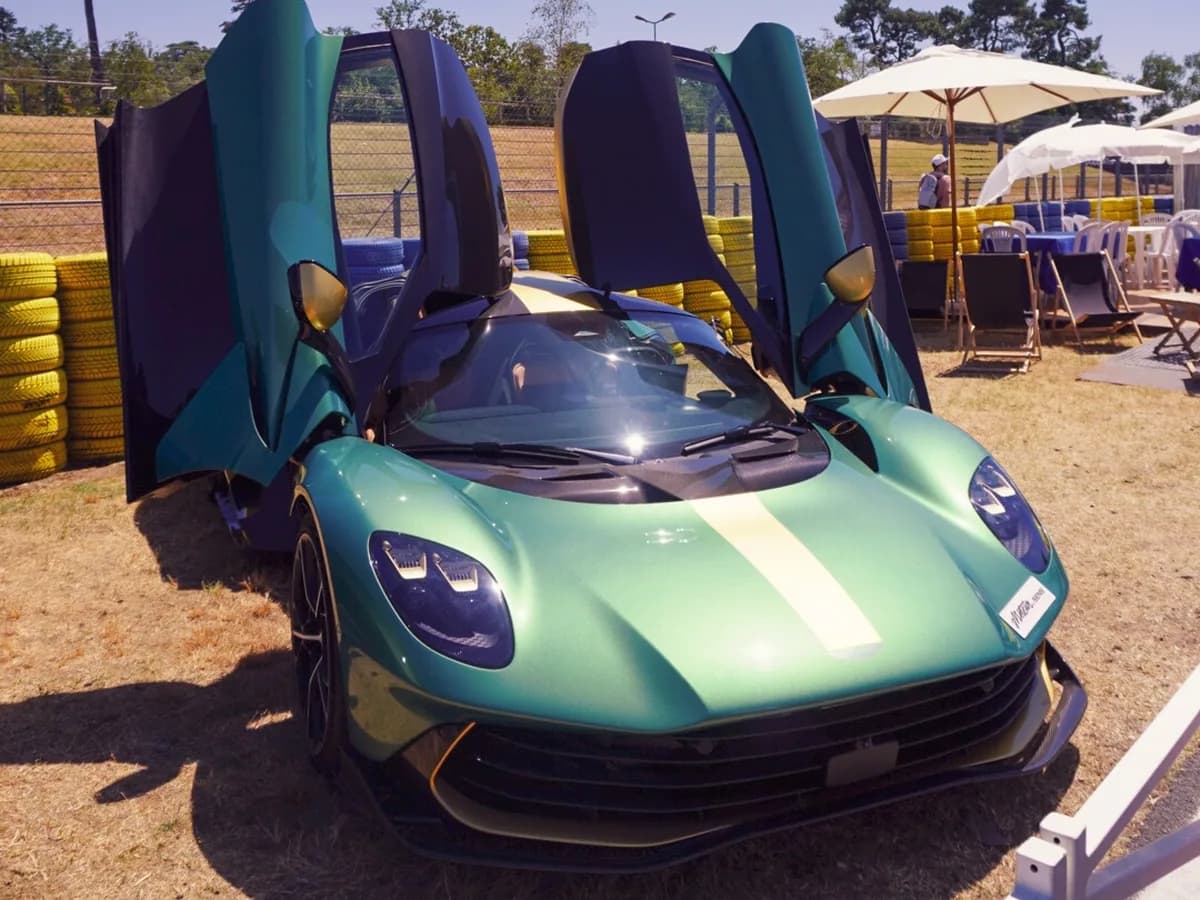
The Aston Martin Valhalla is a mid-engined plug-in hybrid supercar and the British marque’s first series-production model built around this layout. First shown as the AM-RB 003 concept at the 2019 Geneva Motor Show, it developed into a road-and-track-focused coupé with technology influenced by Aston Martin’s Formula 1 activities. Its powertrain combines a 4.0-litre twin-turbocharged V8 with three electric motors, producing a claimed 1,079 PS in total. Aston Martin quotes a 0–100 km/h time of 2.5 seconds and an electronically limited top speed of 350 km/h. Production is restricted to 999 cars worldwide, with industrialisation and first deliveries scheduled around 2025.
Curious about this car?
Explore Valhalla, then try your own photo.
No account needed for the result · Publish only if you choose
The Valhalla project first appeared in March 2019 as the AM-RB 003, Aston Martin’s third mid-engined sports-car programme developed with Red Bull Advanced Technologies. It was positioned below the Valkyrie within the brand’s planned mid-engined range. In June 2019, Aston Martin confirmed the Valhalla name, linking the car to Norse mythology and the company’s long-running use of V-themed performance names. The original proposal called for a turbocharged V6 and plug-in hybrid system, with an announced run of 500 carbon-fibre coupés. The project subsequently underwent major technical and design changes. Later specifications introduced a twin-turbocharged flat-plane-crank V8, three electric motors and an eight-speed dual-clutch transmission. In December 2024, Aston Martin released detailed production-car information and confirmed that the programme had entered industrialisation. Production was planned to start in the second quarter of 2025, with initial customer deliveries expected during the second half of that year.
Photos added by the community for this page.
Source: Aston Martin Media
The Valhalla name comes from Norse mythology, describing the hall where fallen warriors are received. Aston Martin selected it to follow the naming theme established by the Valkyrie, the more extreme member of its mid-engined performance programme. The car also represents an important technical first for the marque: it was developed as Aston Martin’s first series-production mid-engined model and its first plug-in hybrid vehicle.
Production of the Valhalla is officially capped at 999 cars worldwide. That figure is higher than the 500 coupés announced when the AM-RB 003 project was first named in 2019, reflecting the evolution from an advanced concept into a more industrialised production vehicle. In December 2024, Aston Martin stated that the programme had entered its industrialisation phase, with production scheduled to begin in the second quarter of 2025 and first deliveries expected in the second half of the year. The available sources do not establish a detailed allocation by market, a complete chassis-number schedule or the exact number of cars assembled during the 2025 model year, so those points remain unspecified.
Early automotive coverage was based largely on advanced development prototypes rather than customer-delivered production cars. Reviews generally highlighted the Valhalla’s importance to Aston Martin because it combines supercar architecture, plug-in hybrid technology and a broader usability target than the Valkyrie. MotorTrend described it as a potentially important model for the company’s next phase, while noting that some transmission software calibration remained unfinished during its drive. Those early assessments should therefore be treated as provisional. Chassis tuning, software, transmission behaviour and final production details could still change before the full customer run was established.
Caractéristiques détaillées du modèle de série annoncées en décembre 2024 : groupe hybride, puissance, transmission, aérodynamique et calendrier de production.
Origine du projet AM-RB 003, choix du nom Valhalla, première architecture hybride annoncée et prévision initiale de 500 coupés.
Évolution technique du programme, influence de la Formule 1, moteurs électriques avant, transmission intégrale et développement du groupe hybride.
Présentation officielle actuelle du modèle et rappel de la production limitée à 999 unités, de la puissance cumulée et des performances revendiquées.
Essai d’un prototype avancé en 2025 et premières observations journalistiques sur le positionnement, le comportement et l’importance du modèle.
Source found by OpenAI web search for this vehicle page.
Source found by OpenAI web search for this vehicle page.
Source found by OpenAI web search for this vehicle page.