
GTV
The Alfa Romeo GTV name used here refers to the Alfetta-based coupé that first appeared in 1974 as the Alfetta GT. Styled by Giorgetto Giugiaro with Italdesign involvement, it combined a front-mounted engine, rear-wheel drive, and a rear transaxle. That layout, paired with a De Dion rear axle, was intended to improve weight distribution and deliver precise handling. The coupé received a major update in 1980: its exterior was modernized, the Alfetta name was gradually dropped from the commercial designation, and the GTV6 2.5 became the best-known performance derivative. ScanRacer’s supplied year range runs from 1980 to 1994, but it should be interpreted carefully. The type 116 Alfetta coupé is documented through 1986, while a separate GTV, known as type 916, emerged in the mid-1990s. (stellantisheritage.com)
Variants by year
1994

1980
Model summary
Data from the ScanRacer library, organized to compare versions quickly.
Model introduction
The Alfa Romeo GTV name used here refers to the Alfetta-based coupé that first appeared in 1974 as the Alfetta GT. Styled by Giorgetto Giugiaro with Italdesign involvement, it combined a front-mounted engine, rear-wheel drive, and a rear transaxle. That layout, paired with a De Dion rear axle, was intended to improve weight distribution and deliver precise handling. The coupé received a major update in 1980: its exterior was modernized, the Alfetta name was gradually dropped from the commercial designation, and the GTV6 2.5 became the best-known performance derivative. ScanRacer’s supplied year range runs from 1980 to 1994, but it should be interpreted carefully. The type 116 Alfetta coupé is documented through 1986, while a separate GTV, known as type 916, emerged in the mid-1990s. (stellantisheritage.com)
History
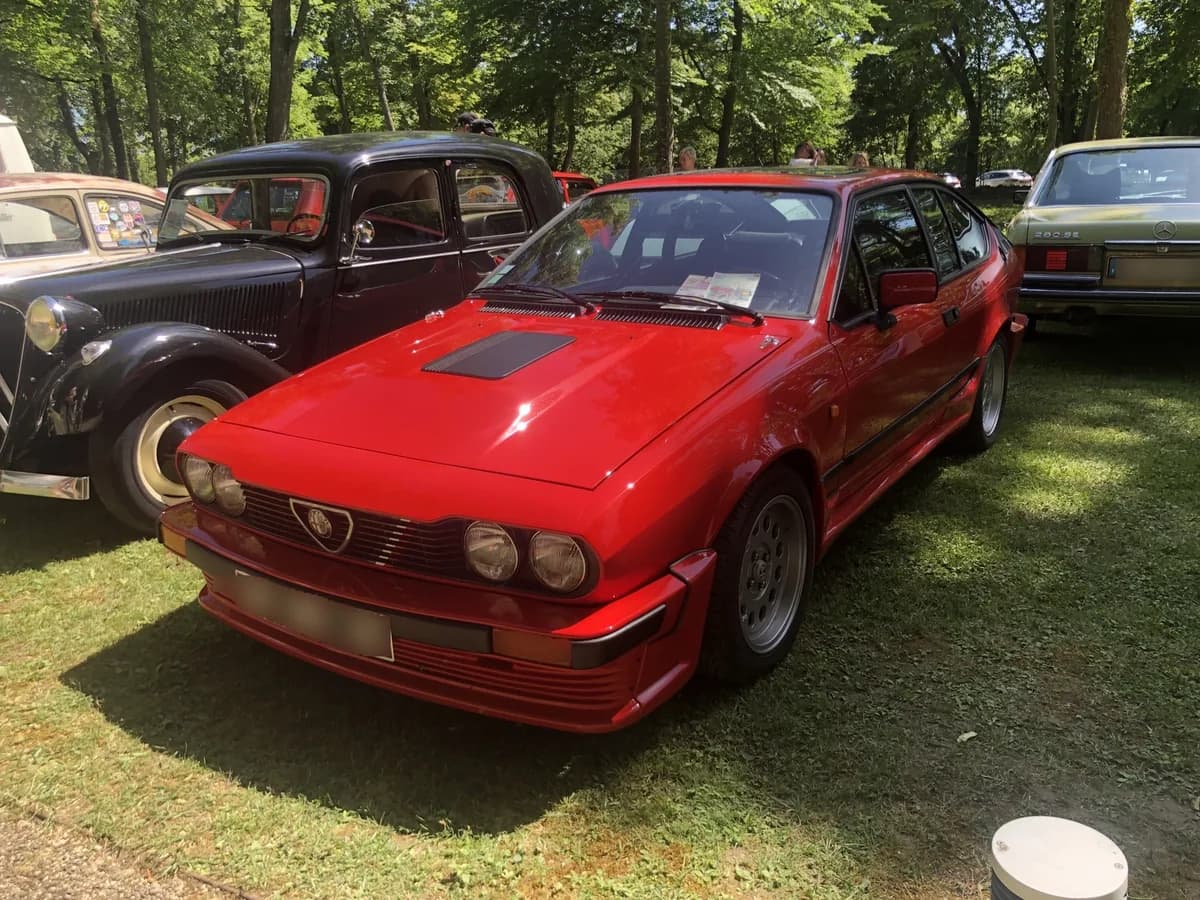
The Alfetta introduced in 1972 gave Alfa Romeo an ambitious new platform featuring a front engine, rear transaxle, and De Dion rear suspension. Two years later, the same foundation produced a shorter, sportier coupé called the Alfetta GT. Giugiaro’s design used a sharply creased fastback shape while retaining more usable accommodation than many contemporary 2+2 coupés. The range began with a 1.8-liter twin-cam four-cylinder and was later expanded with 1.6- and 2.0-liter engines. (stellantisheritage.com) For 1980, Alfa Romeo substantially revised the coupé. Larger bumpers replaced the earlier slim items, bright trim was reduced in favor of darker finishes, the rear lamps were redesigned, and the cabin was updated. The 2.0-liter four-cylinder became central to the revised range. That same year, the GTV6 introduced a 2.5-liter V6 derived from the Alfa 6 unit and equipped with Bosch L-Jetronic electronic fuel injection. Its raised hood, required to clear the intake system, became the car’s most recognizable visual feature. A further update arrived in 1983, affecting the interior and selected exterior details. Alfa Romeo/Stellantis Media records the Alfetta GTV coupé as continuing until 1986. (media.stellantis.com)
Generations
Within the relevant period, it is more accurate to describe a single technical family with major revisions than entirely separate generations. The first phase is the Alfetta GT, introduced in 1974 on a shortened version of the Alfetta sedan platform. Typical early cars feature slim bumpers, more extensive bright trim, and first-series interior details. Their mechanical identity comes from the twin-cam four-cylinder engines and the Alfetta family’s rear transaxle layout. (stellantisheritage.com) The second phase began in 1980 with the facelifted model, described as the GTV or GTV 2.0 depending on market and documentation. Plastic bumpers, one-piece rear lamps, side protection, and darker trim gave the car a visibly more modern appearance. The GTV6 2.5 belongs to this same type 116 development, but stands apart through its V6 engine and raised hood. Another update followed around 1983, bringing changes to the dashboard, trim, and selected exterior details. (media.stellantis.com) This family should not be confused with the type 916 GTV introduced in the mid-1990s, which used a different design and engineering basis. The 1994 date in the ScanRacer range may therefore represent naming or catalog coverage rather than uninterrupted production of the Alfetta-based coupé. (autobild.de)
Key differences
The easiest differences to establish are visual. Early Alfetta GT cars use slimmer bumpers and more brightwork, while the 1980 revision adopts plastic bumpers, redesigned rear lamps, and darker exterior trim. Fifteen-inch wheels are also associated with the facelifted version in several markets and period documents. (media.stellantis.com) The main mechanical distinction is between the four-cylinder cars and the GTV6. The latter uses a 2.5-liter V6 with electronic fuel injection and is often identifiable by its raised hood. Interior trim, dashboard design, transmission ratios, and equipment can nevertheless vary with model year and market. Identification should therefore be checked against the chassis number, identification plate, and original documentation rather than relying on one visual feature. The 1990s type 916 GTV is a separate car, despite using the same GTV name. (gtv6-156gta.be)
Photo recognition
An Alfetta-family GTV can be recognized by its fastback coupé profile, long hood, and forward-set cabin. Early cars have a brighter appearance, with narrow bumpers and more chrome trim. After 1980, plastic bumpers, broader rear lamps, and black side protection give the body a heavier, more modern look. The tachometer mounted directly in front of the driver is another interior clue commonly associated with the model’s sporting layout. (media.stellantis.com) On a GTV6, the raised hood is the most obvious exterior identifier, although it cannot by itself confirm that a car is original. Badges, wheels, dashboard design, and upholstery should be checked against documentation for the relevant market and model year. Very large bumpers may indicate a North American-market car, but they are not sufficient to date an example precisely. A GTV with a much rounder, more modern body is more likely to be the later type 916 rather than the type 116 Alfetta coupé. (gtv6-156gta.be)
Important versions
The GTV 2.0 is the principal four-cylinder derivative of the facelifted period. It retains the twin-cam engine and rear transaxle layout while adopting the body revisions introduced in 1980. The GTV6 2.5 is the best-known member of the family, distinguished by its fuel-injected V6 and raised hood. Special derivatives such as the Turbodelta and market-specific versions are documented separately and should not be inferred from the GTV name alone. In the supplied ScanRacer context, the available variant is labeled “Base”; that catalog label does not establish a specific engine or trim level for every individual car. (gtv6-156gta.be)
The name “GTV” follows Alfa Romeo naming, with its rules and its exceptions. Decode a Alfa Romeo name
References
- Alfa Romeo Alfetta GT & GTV buying guideOctane
- Alfa Romeo Alfetta GT/GTV buying guideHemmings
- Alfa Romeo GTV IAUTO BILD
- https://classics.honestjohn.co.uk/reviews/alfa-romeo/alfetta-gtv-and-gtv6/buyingclassics.honestjohn.co.uk
Frequently asked questions
- What years was the Alfa Romeo GTV produced?
- ScanRacer's referenced versions cover 1980 - 1994.
- How many Alfa Romeo GTV examples are documented on ScanRacer?
- 3 published scans from 3 members, with the latest photo added in August 2026.