
Giulia
Introduced at Monza on June 27, 1962, the Alfa Romeo Giulia became one of the most recognizable models in the Milanese marque’s history. The original generation combined a four-door family body with an all-alloy twin-cam four-cylinder engine, a five-speed manual gearbox, and rear-wheel drive. Its range quickly expanded to include 1300, Super, TI, Sprint, Spider, coupé, and Giardinetta derivatives, with body and engine developments continuing through 1978. The Giulia name returned in 2015 for a new rear-wheel-drive sedan that went on sale from 2016. That second generation placed the Quadrifoglio at the top of the range, followed in 2020 by the highly limited GTA and GTAm models. These performance variants deliberately connected the modern sedan with Alfa Romeo’s lightweight, competition-focused GTA heritage.
Variants by year
2020
2016
 C
C1974
1965
1963
1962
Model summary
Data from the ScanRacer library, organized to compare versions quickly.
Model introduction
Introduced at Monza on June 27, 1962, the Alfa Romeo Giulia became one of the most recognizable models in the Milanese marque’s history. The original generation combined a four-door family body with an all-alloy twin-cam four-cylinder engine, a five-speed manual gearbox, and rear-wheel drive. Its range quickly expanded to include 1300, Super, TI, Sprint, Spider, coupé, and Giardinetta derivatives, with body and engine developments continuing through 1978. The Giulia name returned in 2015 for a new rear-wheel-drive sedan that went on sale from 2016. That second generation placed the Quadrifoglio at the top of the range, followed in 2020 by the highly limited GTA and GTAm models. These performance variants deliberately connected the modern sedan with Alfa Romeo’s lightweight, competition-focused GTA heritage.
History
The first Giulia was unveiled at the Monza circuit in 1962 as the successor to the Giulietta. Its design combined a compact but roomy sedan body with an all-alloy twin-cam four-cylinder engine and rear-wheel drive. The Alfa Romeo Museum records 572,646 Giulia saloons produced between 1962 and 1978. The model also became the foundation for a broad family of cars, including the 1300 TI, Super, TI Super, Nuova Super, Sprint and GT derivatives, plus open and utility-bodied versions built with specialist coachbuilder involvement. Engine development progressed from 1.3- and 1.6-litre units to the larger 1750 and 2000 sedans, while the Giulia retained its traditional front-engine, rear-wheel-drive layout. Production ended in the late 1970s as newer, larger Alfa Romeo models took over the range. The name returned with an entirely new sedan revealed in 2015 and introduced from 2016. This second Giulia used a rear-wheel-drive architecture, balanced weight distribution, and modern powertrains, including the Quadrifoglio’s twin-turbo V6. In 2020, the GTA and GTAm extended the model’s story with a much more focused performance brief.
Generations
The historic Giulia, generally associated with Alfa Romeo’s Type 105 family, covers the 1962-1978 period. It is identified by its four-door notchback body, longitudinal engine, and rear-wheel-drive layout. The different versions did not all serve the same purpose: the 1300 emphasized accessibility, the Super added equipment and refinement, while the TI Super focused more strongly on reduced weight and performance. Sprint, GT, Spider, and Giardinetta names refer to related body styles or closely connected derivatives rather than to one single sedan trim. The Nuova Super represents one of the final developments of this original family. The second generation belongs to a different technical era and is not a direct mechanical evolution of the 1960s car. Revealed in 2015, it uses a rear-wheel-drive platform, modern suspension systems, and a range that included Giulia, Super, and Quadrifoglio versions. The Quadrifoglio is defined by its 2.9-litre twin-turbo V6 producing 510 hp. The 2020 GTA and GTAm are based on that model: the GTA retains four seats, while the GTAm uses two seats, a roll bar, and a more track-oriented specification. The two generations share a name and sporting intent, but their structures, dimensions, technologies, and intended uses are fundamentally different.
Key differences
The most important distinction is chronological and technical. A Giulia from the 1960s or 1970s is a lightweight sedan with a naturally aspirated four-cylinder engine, manual transmission, and rear-wheel drive, along with period-style instrumentation and trim. The 1300, 1600, 1750, and 2000 versions differ mainly through displacement, equipment, and presentation. Sprint, GT, Spider, and Giardinetta models use distinct body styles and should not be treated as simple trim levels. The modern Giulia, introduced from 2016, is wider, lower, and considerably more sophisticated. Depending on the market, it could be equipped with an eight-speed automatic transmission and petrol or diesel engines. The Quadrifoglio is defined by its 510-hp twin-turbo V6, while the 2020 GTA and GTAm add 540 hp, dedicated aerodynamic components, and extensive weight-saving measures. The historic and modern names therefore do not describe one continuously developed generation. They identify two separate Giulia families divided by several decades of engineering and design development.
Photo recognition
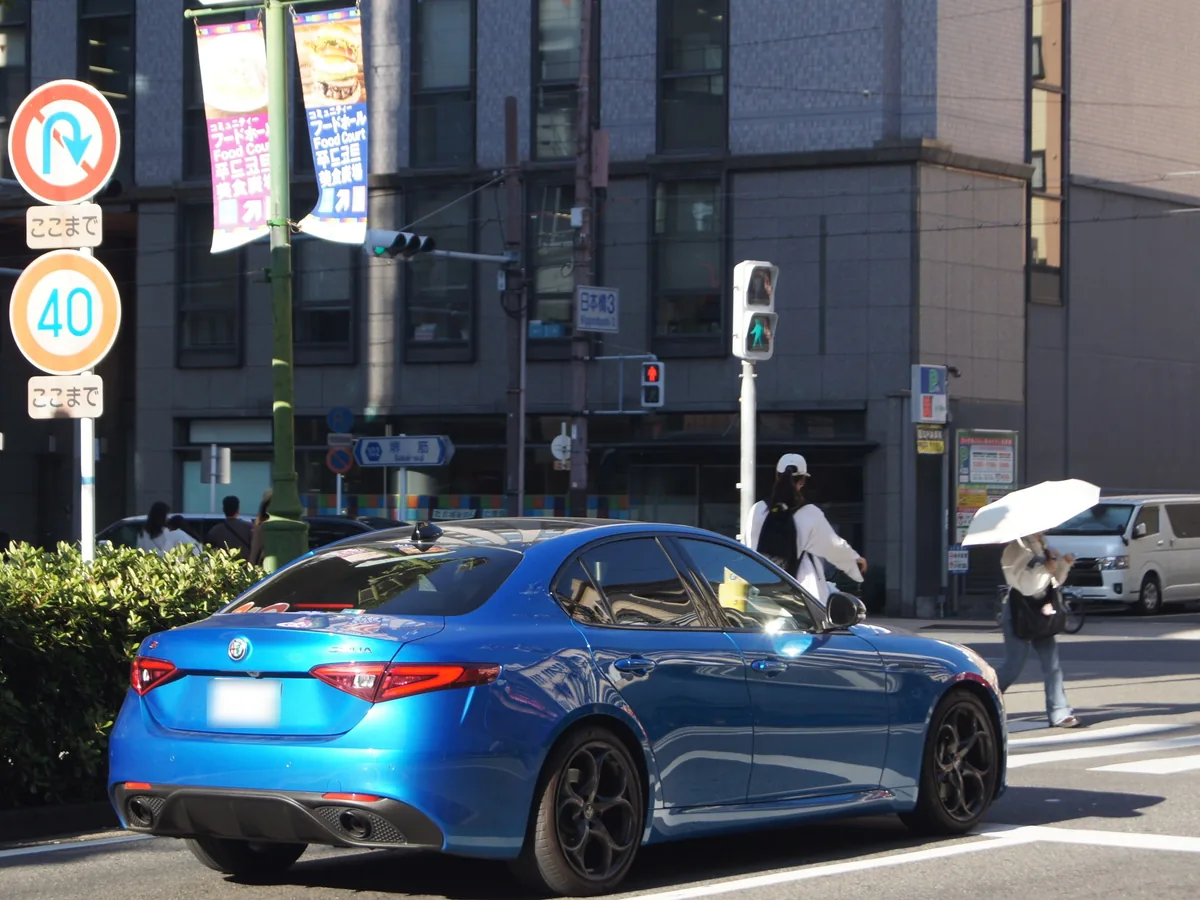
To identify a historic Giulia, start with the three-box four-door shape, relatively long hood, and short rear deck. The original sedan has a narrow Alfa Romeo grille, often accompanied by four round headlamps on the best-known versions, although details vary with model year and trim. 1300, 1600, Super, Nuova Super, and TI badges can provide clues, but they are not enough on their own to establish a precise year. Wheels, bumpers, grille treatment, and lamp shapes changed during production. A Sprint or GT is more readily identified by its coupé body, while a Spider has an open configuration and a Giardinetta uses an extended rear section. The modern Giulia has a much lower and more sculpted four-door profile, an unmistakable shield grille, swept-back lamps, and a strongly angled rear pillar. Quadrifoglio models add more visible air openings, side skirts, and aerodynamic details. The GTA and GTAm are distinguished by extensive carbon-fibre components, wider tracks, and, on the GTAm, the deletion of the rear bench in favor of a more competition-oriented interior.
Important versions
Among the historic versions, the 1962 Giulia TI is the foundational model, while the 1300 TI and Super helped broaden the range’s appeal. The TI Super is especially notable for its sporting focus and weight-saving measures. Sprint and GT derivatives gave Giulia mechanicals a coupé expression, while the Spider and Giardinetta bodies demonstrate the variety of coachbuilt forms associated with the name. The Nuova Super represents a late development of the classic sedan. In the modern generation, the Quadrifoglio is the performance benchmark, using a 510-hp twin-turbo V6. The 2020 GTA and GTAm build on that foundation with 540 hp and a total production run limited to 500 cars. The GTAm goes further with two seats, a roll bar, and a more radical specification aimed at intensive sporting use.
The name “Giulia” follows Alfa Romeo naming, with its rules and its exceptions. Decode a Alfa Romeo name
References
- GiuliaMuseo Alfa Romeo
- Giulia before GiuliaMuseo Alfa Romeo
- Alfa Romeo GiuliaStellantis Heritage
- Alfa Romeo Giulia Range Unveiled at the 2016 Geneva Motor ShowAlfa Romeo / Stellantis Media
- Giulia GTA: The Return of an Alfa Romeo LegendAlfa Romeo / Stellantis Media
- Alfa Romeo Giulia QuadrifoglioAlfa Romeo
- https://www.media.stellantis.com/uploads/fr/FR/2012/Alfa_Romeo/COMMUNIQUES/120619_AR_CP_50_ANS_GIULIA_BERLINA.pdfmedia.stellantis.com
Technical specifications
Structured data available for versions linked to this model.
| Version | Power | Torque | Top speed | Drivetrain | Fuel |
|---|---|---|---|---|---|
| — | 150 chevaux | — | — | Propulsion arrière / Transmission manuelle à six rapports | — |
Frequently asked questions
- What years was the Alfa Romeo Giulia produced?
- ScanRacer's referenced versions cover 1962 - 2020.
- How many Alfa Romeo Giulia examples are documented on ScanRacer?
- 15 published scans from 12 members, with the latest photo added in August 2026.
- What is the power output of the Alfa Romeo Giulia?
- The sourced technical data lists 150 chevaux.