
8C
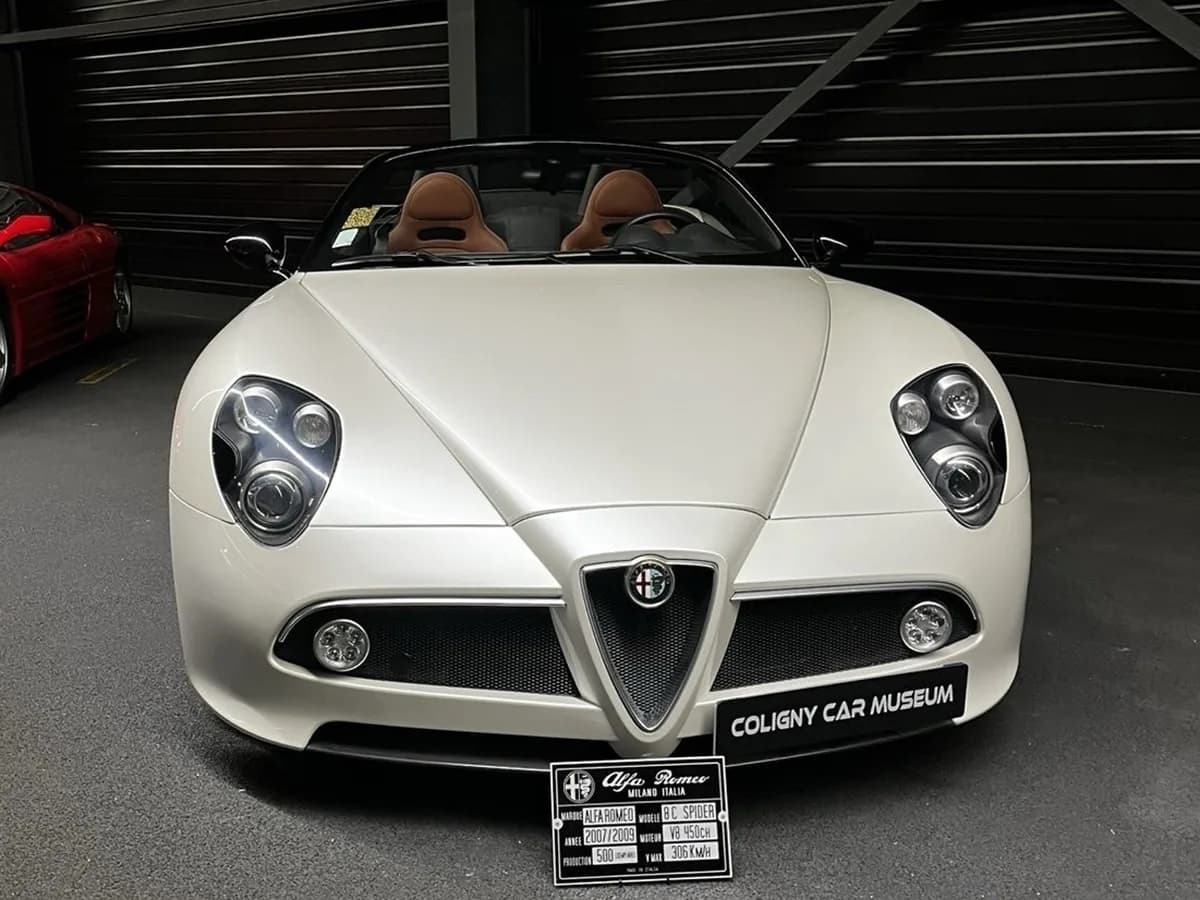
The Alfa Romeo 8C name covers two important chapters in the marque’s sporting history. The original 8C 2300 appeared in 1931 under the technical direction of Vittorio Jano and quickly established a strong competition record, including victories at the Mille Miglia, the Targa Florio, and the 24 Hours of Le Mans. Decades later, the name returned with the 8C Competizione, shown as a concept in 2003 and produced in limited numbers from 2007. Its 4.7-litre V8, rear-wheel drive, and transaxle layout revived several themes associated with Alfa Romeo’s historic sports cars. The 8C Spider followed in 2008, applying the same broad mechanical formula to an open body. In ScanRacer’s catalogue, these periods are represented by the Classic model, Competizione, and Spider entries.
Variants by year
2008
2007
1931
Model summary
Data from the ScanRacer library, organized to compare versions quickly.
Model introduction
The Alfa Romeo 8C name covers two important chapters in the marque’s sporting history. The original 8C 2300 appeared in 1931 under the technical direction of Vittorio Jano and quickly established a strong competition record, including victories at the Mille Miglia, the Targa Florio, and the 24 Hours of Le Mans. Decades later, the name returned with the 8C Competizione, shown as a concept in 2003 and produced in limited numbers from 2007. Its 4.7-litre V8, rear-wheel drive, and transaxle layout revived several themes associated with Alfa Romeo’s historic sports cars. The 8C Spider followed in 2008, applying the same broad mechanical formula to an open body. In ScanRacer’s catalogue, these periods are represented by the Classic model, Competizione, and Spider entries.
History
The first 8C arrived in 1931 as the 8C 2300. Designed by Vittorio Jano, it used a supercharged 2.3-litre straight-eight and was offered with different wheelbases and body styles. The model became one of the central cars of Alfa Romeo’s most successful pre-war period. The Museo Alfa Romeo credits the 8C 2300 family with achievements at the Mille Miglia, the Targa Florio, Le Mans, and Grand Prix events, including success for the Monza version. The family later expanded into larger-engined cars such as the 8C 2600 and 8C 2900, although these should not be treated as the same generation as the modern 8C Competizione. The name was revived with the 8C Competizione concept shown in 2003. Alfa Romeo subsequently developed it into a production car, presenting the final version in 2006 and beginning production from 2007. The coupe was limited to 500 numbered examples. In 2008, the 8C Spider became its open-top counterpart, also described by the manufacturer as a 500-car limited series. This revival combined styling cues associated with historic Alfa Romeo sports cars with contemporary hardware: a 4.7-litre V8 producing 450 hp, rear-wheel drive, and a six-speed automated manual transmission.
Generations
The Alfa Romeo 8C catalogue does not represent a conventional sequence of model generations carrying the same name. Instead, it connects a historic family of 1930s racing and grand-touring cars with a modern, highly limited-production sports car. The Classic model entry refers to the launch of the 8C 2300 in 1931. This was a pre-war straight-eight sports car offered with different body styles and chassis lengths, so period examples can vary considerably in appearance. Names such as 8C 2300, 8C Monza, 8C 2600, and 8C 2900 belong to this broader technical and competition history, although not all of them appear as separate variants in the supplied catalogue context. The second period begins with the 8C Competizione. The modern coupe uses a two-seat body with rounded, sculptural surfaces, a structure incorporating aluminium and composite materials, and a longitudinally mounted front V8. Its rear-mounted gearbox creates a transaxle layout intended to improve weight distribution. The 2008 8C Spider retains the Competizione’s main mechanical theme but replaces the fixed roof with an open body. It is therefore best understood as an open derivative of the modern 8C revival rather than as a wholly separate generation.
Key differences
The key distinction is between the historic 8C and the modern Competizione and Spider. The 1931 car belongs to an era of separate chassis, coachbuilt bodies, and supercharged straight-eight engines. Its appearance can therefore change substantially according to body style, wheelbase, and whether the car was intended for competition or road use. The modern 8C Competizione is a limited-production two-seat coupe. It uses a 4.7-litre V8 producing 450 hp, rear-wheel drive, a six-speed automated manual gearbox, and a transaxle layout. The Spider retains this broad mechanical specification but replaces the fixed roof with an open body and folding roof system. Alfa Romeo communications identify production runs of 500 cars for the coupe and 500 for the Spider. These distinctions are sufficient to separate the ScanRacer entries without assuming undocumented market variations or equipment packages.
Photo recognition
To identify a historic 8C, first establish the period and body style rather than relying only on the badge. A 1931 8C 2300 normally has the proportions of a pre-war racing or grand-touring car, with separate fenders, exposed or partly integrated wheels, and coachbuilt bodywork shaped around the chassis. Monza and Le Mans versions can look notably different from one another. The modern 8C Competizione is recognisable by its low two-door coupe body, pronounced rear haunches, Alfa Romeo shield grille, and twin exhaust outlets. Its side profile includes a distinctive horizontal cut or crease behind the front wheel arch, a feature shown in Alfa Romeo’s concept presentation material. Large wheels and wider rear tyres reinforce its stance. The Spider uses the same overall design language, but its open cabin and lack of a fixed roof provide the clearest visual distinction. A reliable identification should still be checked against the model year, chassis number, or a documented historical source when a car has been modified or fitted with non-original bodywork.
Important versions
The 1931 8C 2300 is the essential historic reference: it introduced the family and established its competition reputation. The Monza and Le Mans versions are especially important for understanding the range of bodies and intended uses during this period. The 8C 2600 and 8C 2900 later extended Alfa Romeo’s pre-war straight-eight development, but they are not identical to the 8C 2300. In the modern era, the 2007 8C Competizione is the coupe that established the name’s revival. The 2008 8C Spider is its open-top derivative. Both use the 4.7-litre V8 and were built in limited numbers, which helps explain their particular significance to collectors.
The name “8C” follows Alfa Romeo naming, with its rules and its exceptions. Decode a Alfa Romeo name
References
- 8C 2300Museo Alfa Romeo
- Storie Alfa Romeo: 8C CompetizioneAlfa Romeo / Stellantis Media
- World preview: The Alfa Romeo 8C CompetizioneAlfa Romeo / Stellantis Media
- Arriva negli States la prima Alfa 8C CompetizioneAlfa Romeo / Stellantis Media
- https://www.media.stellantis.com/de-de/alfa-romeo/press/genfer-automobilsalon-2008-der-alfa-8c-spider-wird-gebautmedia.stellantis.com
- https://www.media.stellantis.com/it-it/alfa-romeo/press/l-alfa-romeo-8c-spider-vincitrice-al-concorso-d-eleganza-villa-d-estemedia.stellantis.com
- https://exclusivecarregistry.com/details/alfa-romeo/8c-2300/67360exclusivecarregistry.com
Technical specifications
Structured data available for versions linked to this model.
| Version | Power | Torque | Top speed | Drivetrain | Fuel |
|---|---|---|---|---|---|
| Base | 331 KW @ 7000 RPM 450 HP @ 7000 RPM 444 BHP @ 7000 RPM | 347 lb-ft @ 4750 RPM 470 Nm @ 4750 RPM | 180.2 mph (290 km/h) | Rear Wheel Drive / 6-speed automatic | Gasoline |
Frequently asked questions
- What years was the Alfa Romeo 8C produced?
- ScanRacer's referenced versions cover 1931 - 2008.
- How many Alfa Romeo 8C examples are documented on ScanRacer?
- 4 published scans from 4 members, with the latest photo added in August 2026.
- What is the power output of the Alfa Romeo 8C?
- The sourced technical data lists 331 KW @ 7000 RPM 450 HP @ 7000 RPM 444 BHP @ 7000 RPM.