
124
The Abarth 124 Spider is a two-seat roadster with a front-mid-mounted engine and rear-wheel drive, unveiled at the Geneva Motor Show in February 2016 and announced for European sale from September that year. Its 1.4-litre four-cylinder Turbo MultiAir engine produces 170 hp and 250 Nm, paired with either a six-speed manual or six-speed automatic transmission. Abarth adds a mechanical limited-slip differential, Bilstein dampers, Brembo front brakes, and a Record Monza exhaust. The car shares its basic architecture with the Fiat 124 Spider, which was closely related to the ND-generation Mazda MX-5, but it has its own bodywork and chassis calibration. Its styling references the historic Fiat 124 Sport Spider, while selected colors and details recall Abarth’s competition heritage. Official specifications list a 0–100 km/h time of 6.8 seconds for the manual car.
What about the car you photographed?
Upload a photo to get a suggested make, model and likely year.
No account needed for the result · Publish only if you choose
Variants by year
Make: Abarth · Model: 124
1 / 1 versions shown
2016
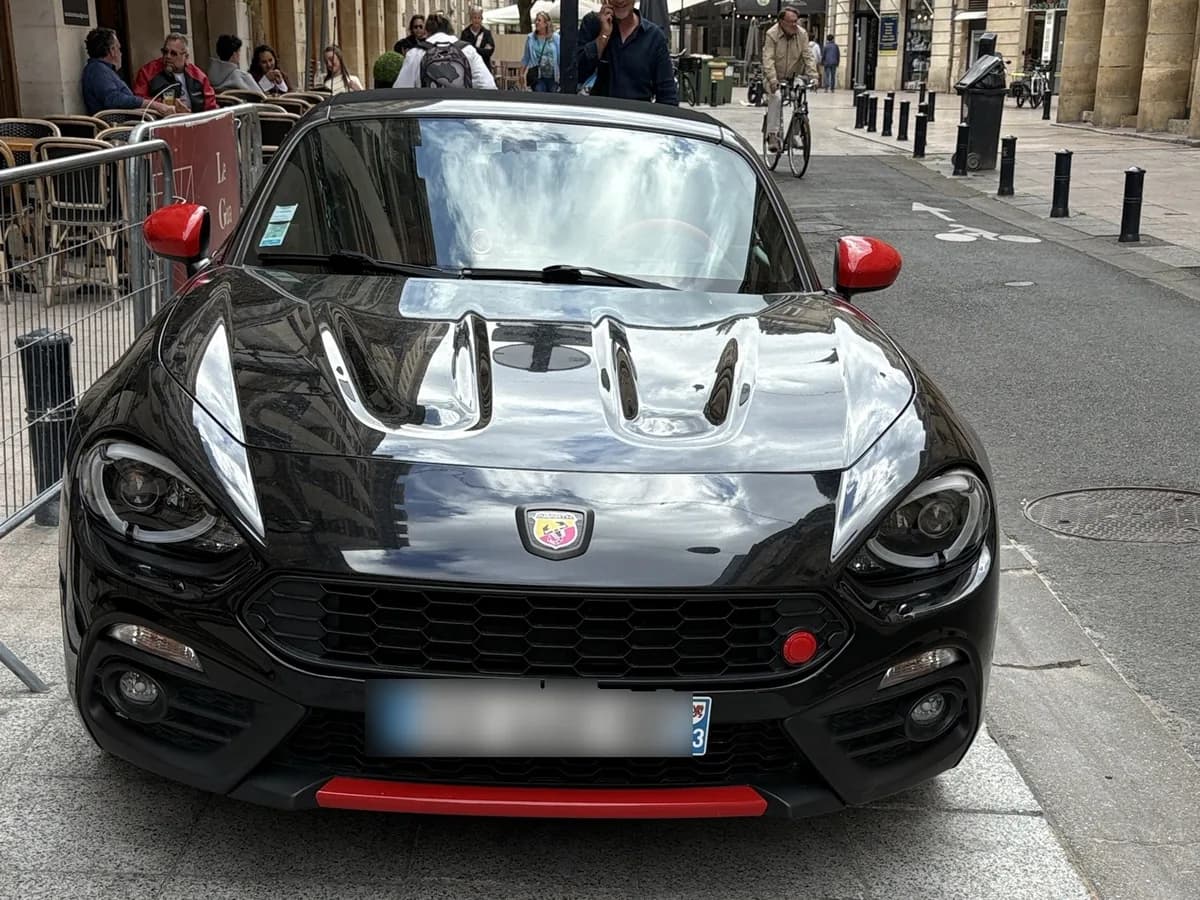
Abarth 124 photos
Model summary
Data from the ScanRacer library, organized to compare versions quickly.
Model introduction
The Abarth 124 Spider is a two-seat roadster with a front-mid-mounted engine and rear-wheel drive, unveiled at the Geneva Motor Show in February 2016 and announced for European sale from September that year. Its 1.4-litre four-cylinder Turbo MultiAir engine produces 170 hp and 250 Nm, paired with either a six-speed manual or six-speed automatic transmission. Abarth adds a mechanical limited-slip differential, Bilstein dampers, Brembo front brakes, and a Record Monza exhaust. The car shares its basic architecture with the Fiat 124 Spider, which was closely related to the ND-generation Mazda MX-5, but it has its own bodywork and chassis calibration. Its styling references the historic Fiat 124 Sport Spider, while selected colors and details recall Abarth’s competition heritage. Official specifications list a 0–100 km/h time of 6.8 seconds for the manual car.
History
The 124 name connects the modern car with Fiat’s long sports-car tradition, but the contemporary Abarth 124 Spider was not simply a production restart of the 1960s and 1970s model. The roadster was introduced in 2016 as a more focused performance derivative of the Fiat 124 Spider. Its development came from the FCA–Mazda partnership: the basic structure, cabin, and part of the chassis architecture were related to the ND-generation MX-5, while Fiat and Abarth altered the styling, powertrain, and suspension tuning. That background helps explain the car’s compact dimensions, low mass, and rear-wheel-drive layout. Abarth unveiled the car at the Geneva Motor Show on February 29, 2016, announcing European availability from September. The company positioned it as the return of the 124 Spider to the Abarth range, roughly four decades after the sporting Fiat 124 Abarth Rally. The launch specification used a 170-hp 1.4-litre Turbo MultiAir engine, a mechanical limited-slip differential, and a standard Record Monza exhaust. Its commercial life was relatively short; established automotive references generally place production and sales in the 2016–2019 period. Exact equipment and naming could vary between markets, so individual cars should be checked against their original documentation.
Generations
The modern Abarth 124 Spider represents a single commercial generation launched in 2016. The available evidence does not support dividing the model into several distinct generations. Instead, it was a short-lived roadster with a consistent overall architecture and powertrain, alongside market-specific equipment and later special editions. Abarth’s 2016 technical sheet describes a 1,368cc four-cylinder engine using MultiAir technology and turbocharging. It produces 170 hp at 5,500 rpm and 250 Nm at 2,500 rpm, with power sent to the rear wheels. Buyers could choose between a six-speed manual gearbox and a six-speed automatic. Published unladen weight is 1,060 kg for the manual car and 1,080 kg for the automatic, while the claimed 0–100 km/h times are 6.8 and 6.9 seconds respectively. Equipment changes, special editions, and regional specification differences appeared during the car’s career, but they do not amount to a separate generation. It is therefore more accurate to describe the model as one 2016–2019 generation offered in different market configurations. Production dates and trim names may differ in registration databases, so a vehicle’s build plate, VIN record, and original market literature remain the best way to identify an individual example.
Key differences
Compared with the Fiat 124 Spider, the Abarth is defined first by its 1.4-litre Turbo MultiAir engine, rated at 170 hp rather than the lower output used by the Fiat version. A mechanical limited-slip differential is standard, along with Abarth by Bilstein dampers, uprated anti-roll bars, Brembo front brakes, and a Record Monza exhaust. Abarth also gave the suspension and electronic systems a more performance-oriented calibration. The comparison with the Mazda MX-5 needs more precision. The two cars share a technical foundation and elements of their basic architecture, but the Abarth uses a different turbocharged engine, 124-specific bodywork, and its own chassis tuning. It is therefore inaccurate to describe it as merely a rebadged MX-5. Equipment could vary by country: comfort features, infotainment, braking hardware, interior trim, and available options were not necessarily identical across all markets. The original sales brochure or vehicle build record is preferable when identifying a particular car.
Photo recognition
The Abarth 124 Spider can be identified by its compact two-seat roadster body, long bonnet, and rear-set cabin. Its front end uses a hexagonal grille, larger air intakes, and model-specific lighting. The raised bonnet humps are a useful visual clue: they echo the classic 124 Spider and emphasize the engine’s longitudinal installation. At the rear, horizontal lamps, swallow-tail-style rear wings, and a shaped diffuser help distinguish the car from the Mazda MX-5. Seventeen-inch alloy wheels, forged-grey detailing around the windscreen and roll bars, and Scorpion badges are typical Abarth cues. A matt-black bonnet and boot-lid treatment could be included with the Racing anti-glare kit, so that feature should not be treated as mandatory on every example. The four-exit Record Monza exhaust is another strong identifier, although equipment varied between markets and option packages. For a definitive identification, check the manufacturer’s plate, VIN, engine and transmission details, and the original sales documentation rather than relying on appearance alone.
Important versions
The key reference is the 2016 Abarth 124 Spider, also described by the brand as the 2016 Edition. It already contains the model’s core technical identity: a 170-hp 1.4-litre Turbo MultiAir engine, rear-wheel drive, a mechanical limited-slip differential, Brembo brakes, and a Record Monza exhaust. The six-speed manual is the lighter configuration, while the six-speed automatic provides an alternative aimed at easier everyday use. Equipment and trim details could differ between countries and option packages. The label “Base” should therefore be treated as a cautious catalog designation, not automatically as a universally standardized factory trim name. Vehicle-specific documentation remains necessary when determining the exact original specification.
References
- Abarth 124 Spider at the 2016 Geneva International Motor ShowAbarth / Stellantis Media
- Abarth 124 Spider Technical Sheet, 1.4 Turbo MultiAirAbarth / Stellantis Media
- Abarth 124 Spider 2016 EditionAbarth
- Abarth 124 Spider ReviewTop Gear
- Abarth 124 Spider (2016–2019) ReviewEvo
- https://www.honestjohn.co.uk/abarth/124-spider/honestjohn.co.uk
- https://autocatalogarchive.com/wp-content/uploads/2016/10/Abarth-124-Spider-2016-INT.pdfautocatalogarchive.com
- https://www.carsguide.com.au/car-reviews/abarth-124-spider-2016-review-first-australian-drive-46665carsguide.com.au
Technical specifications
Structured data available for versions linked to this model.
| Version | Power | Torque | Top speed | Drivetrain | Fuel |
|---|---|---|---|---|---|
| — | 170 chevaux | — | — | Propulsion arrière / Manuelle 6 vitesses | — |
Frequently asked questions
- What years was the Abarth 124 produced?
- ScanRacer's referenced versions cover 2016.
- How many Abarth 124 examples are documented on ScanRacer?
- 4 published scans from 4 members, with the latest photo added in August 2026.
- What is the power output of the Abarth 124?
- The sourced technical data lists 170 chevaux.
What about the car you photographed?
Upload a photo to get a suggested make, model and likely year.
No account needed for the result · Publish only if you choose