
Maybach
Maybach revived its name in the ultra-luxury car market in 2002 with two large saloons, the Maybach 57 and 62. Their designations referred approximately to their overall lengths: 5.73 metres for the 57 and 6.17 metres for the 62. Built as part of Mercedes-Benz’s internal 240 series, both cars combined a twin-turbocharged V12 engine with extensive factory personalisation and a cabin designed around rear-seat comfort. The 57 used the shorter body, while the 62 offered a longer profile more clearly suited to chauffeur-driven travel. The 57 S and 62 S later added higher engine output and a more dynamic chassis specification. This model family represents the core of Maybach’s modern standalone-car era, before the name became part of the Mercedes-Maybach brand structure.
Models from A to Z
Maybach overview
Maybach history
Maybach’s history begins with Wilhelm Maybach, the engineer who worked with Gottlieb Daimler on engines for road vehicles, boats and aircraft. Wilhelm and his son Karl later established Maybach-Motorenbau, a company that became closely associated with engines for Zeppelin airships. After the First World War, restrictions on German industry encouraged Karl Maybach to move the company toward prestigious automobiles. The Maybach cars of the 1920s and 1930s were built in limited numbers and largely to order, but automobile production ended during the Second World War. Mercedes-Benz officially revived Maybach as an independent automotive brand in 2002. The new 57 and 62 were presented to the public in New York on July 2, 2002, with customer deliveries beginning in autumn of that year. The 57 S debuted at the 2005 Geneva Motor Show, followed by the 62 S the next year. A major update in 2010 revised the exterior design, wheels and available equipment. The final cars from this generation were delivered in early 2013.
Maybach positioning
The Maybach 57 and 62 occupied the top end of the luxury-saloon market, taking a different approach from a conventional executive sedan. Rear passenger comfort, cabin space and extensive personalisation were central to the concept. Depending on the specification, buyers could choose features such as individual rear seats, a partition between the chauffeur and passengers, high-grade trim and advanced entertainment equipment. The 62 was the more formal and chauffeur-focused model because of its longer body, while the 57 offered a slightly more manageable format without becoming a small car. The 57 S and 62 S added a sportier interpretation of the same idea, using a 6.0-litre twin-turbocharged V12 developed with Mercedes-AMG and a firmer suspension setup. They are best understood as high-performance luxury saloons rather than conventional sports cars: their defining qualities remained refinement, rear-seat accommodation and bespoke presentation.
Recognizing a Maybach in a photo
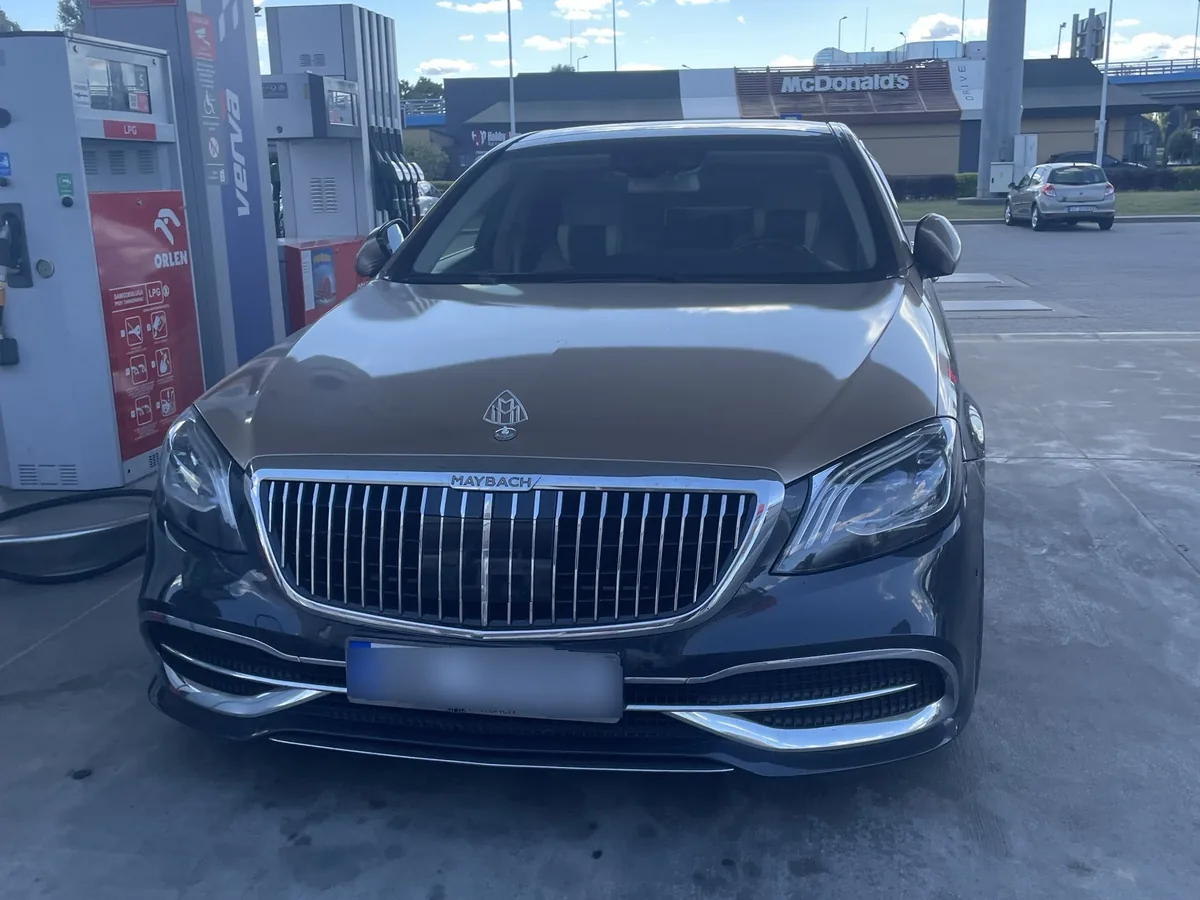
The easiest distinction is body length. The Maybach 57 is approximately 5.73 metres long, while the 62 stretches to about 6.17 metres. In profile, the 62 therefore has a more substantial wheelbase and rear section, giving it a clearer chauffeur-car character. Both models share an upright luxury-saloon shape, a high waistline, a large vertical grille and the double-M emblem, which appeared on several details including the headlamp lenses of early cars. The 57 S and 62 S are mainly identified through their more assertive equipment and styling: 20-inch wheels, revised bumpers, integrated exhaust outlets and, depending on the model year, a grille with heavier double louvres. Identification from one image should still be treated cautiously because Maybach offered numerous paint, wheel and interior combinations. The length of the rear door and the overall side profile are usually more reliable clues than badges alone.
Important Maybach models
The modern generation centres on four closely related models. The Maybach 57 was the standard saloon in the shorter body style, while the 62 followed the same luxury formula with a longer body and a stronger emphasis on rear passenger space. Introduced in 2005, the 57 S added a 6.0-litre twin-turbocharged V12 producing 612 hp at launch, together with firmer suspension and distinctive exterior details. The 62 S received the same higher-performance engine and sportier treatment in 2006 while retaining the advantages of its long-wheelbase body. In the ScanRacer library, these four names form the core of the Maybach models recorded from 2002 to 2010: 57, 62, 57 S and 62 S. Their main differences concern body length, engine output, chassis tuning and the extent of available luxury personalisation.
References
- 240 series Maybach Saloons, 2002–2013Mercedes-Benz Public Archive
- Maybach 57 and Maybach 62Mercedes-Benz Public Archive
- The Maybach Story: A Living LegendMuseum of Historic Maybach Vehicles
- Our History of InnovationThe Wilhelm & Karl Maybach Foundation
- 100 Jahre Maybach Automobilbau: Weltpremiere der limitierten Jubiläumsedition Edition 100Mercedes-Benz Media
- https://maybach.org/maybach.org
- https://maybach.com/maybach-museums/1919-2/maybach.com