
Marsien
The Marc Philipp Gemballa Marsien is an all-terrain sports car developed from the Porsche 911 Turbo S of the 992 generation. Revealed in 2021 as Marc Philipp Gemballa’s first project, it combines completely bespoke carbon-fibre bodywork, all-wheel drive and a chassis engineered for both road use and loose surfaces. Its twin-turbo flat-six was developed with RUF, while KW Automotive contributed to the height-adjustable suspension system. The manufacturer announced a limited run of 40 cars for the original Marsien series. The name refers to the desert environment around Sharjah in the United Arab Emirates, which reportedly reminded the development team of Mars. ScanRacer lists the GT variant for model year 2026. Publicly available manufacturer material does not yet provide enough detail to establish a complete technical comparison between that GT entry and the earlier Marsien series.
Variants by year
2026
Model summary
Data from the ScanRacer library, organized to compare versions quickly.
Model introduction
The Marc Philipp Gemballa Marsien is an all-terrain sports car developed from the Porsche 911 Turbo S of the 992 generation. Revealed in 2021 as Marc Philipp Gemballa’s first project, it combines completely bespoke carbon-fibre bodywork, all-wheel drive and a chassis engineered for both road use and loose surfaces. Its twin-turbo flat-six was developed with RUF, while KW Automotive contributed to the height-adjustable suspension system. The manufacturer announced a limited run of 40 cars for the original Marsien series. The name refers to the desert environment around Sharjah in the United Arab Emirates, which reportedly reminded the development team of Mars. ScanRacer lists the GT variant for model year 2026. Publicly available manufacturer material does not yet provide enough detail to establish a complete technical comparison between that GT entry and the earlier Marsien series.
History
The Marsien project was developed for more than two years before its official presentation in July 2021. It became the first vehicle from Marc Philipp Gemballa GmbH, an independent company separate from Gemballa GmbH and founded by Marc Philipp Gemballa. The concept goes beyond adding rally-inspired styling: it converts a modern Porsche 911 Turbo S into a sports car intended to work on both paved roads and rough terrain. Exterior design was assigned to Alan Derosier, a Porsche enthusiast known for his Porsche-related studies, while a group of specialist suppliers contributed to the engineering programme. The Marsien uses carbon-fibre bodywork, double-wishbone front suspension, adjustable ride height and two wheel sets intended for road and off-road use. RUF worked on the flat-six engine, with the manufacturer quoting more than 750 hp and an optional development capable of reaching 830 hp. Akrapovič supplied a bespoke titanium exhaust system. Following the unveiling, the vehicle was tested in the Sharjah desert, on the Nürburgring Nordschleife, in Scandinavia and on the Sölden glaciers. In July 2024, Marc Philipp Gemballa announced that series production was under way. The company stated that all 40 cars in the original limited series had been sold and were destined for customers in more than 16 countries.
Generations
Available public sources do not describe several officially separate generations of the Marsien. The known timeline begins with the project unveiled in 2021 and continues through engineering, homologation and the limited-series production announced in 2024. The Marsien is therefore better understood as a highly exclusive production model than as a conventional range that progressed through successive generations. The original Marsien uses the technical basis of a Porsche 911 Turbo S from the 992 generation, but the conversion is extensive: full carbon-fibre bodywork, bespoke aerodynamic elements, redesigned front suspension, hydraulic ride-height adjustment and equipment intended for different surfaces. The manufacturer announced a 40-car series for this model. ScanRacer identifies a GT variant dated 2026. That designation should be treated as a variant entry in the ScanRacer database; the official material reviewed does not yet explain its mechanical differences, production volume or precise relationship to the earlier 40-car Marsien series. It would therefore be premature to describe the GT as a separate generation without further confirmation from Marc Philipp Gemballa.
Key differences
The Marsien differs from a standard Porsche 911 Turbo S through a far more extensive conversion than a conventional body kit. Its carbon-fibre bodywork is bespoke, the front suspension uses a double-wishbone layout, and the ride-height system can raise ground clearance to as much as 250 mm according to the manufacturer. It also uses centre-lock forged wheels, separate road and all-terrain tyres, and a titanium exhaust developed by Akrapovič. The flat-six engine receives a RUF upgrade quoted at more than 750 hp, with an optional development reaching 830 hp. For the GT variant listed by ScanRacer for 2026, no sufficiently detailed official source was found establishing its specific technical differences. Its exact engine specification, suspension calibration, production volume and relationship to the original Marsien series should therefore remain unconfirmed until Marc Philipp Gemballa publishes additional information.
Photo recognition
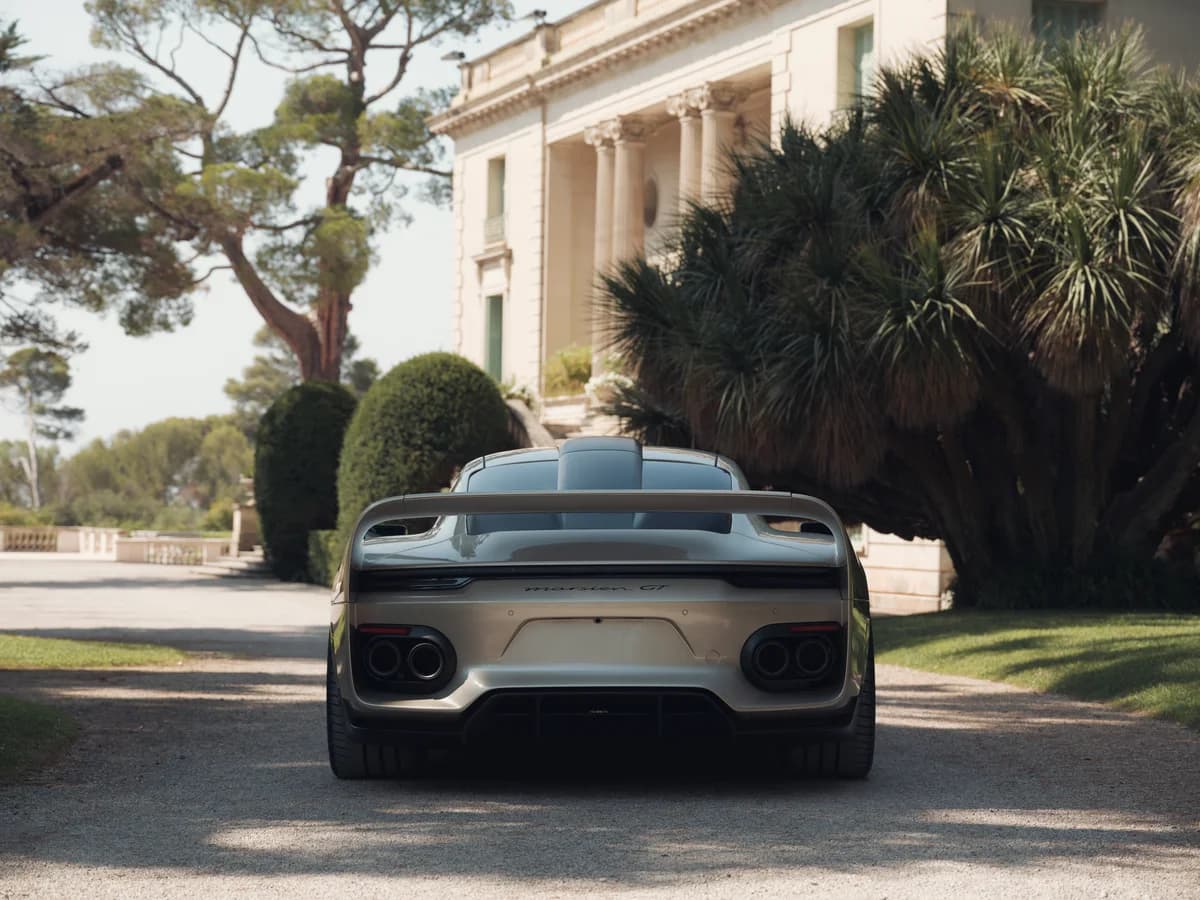
The Marsien is easiest to recognise by its raised and widened 911-like silhouette, although its body panels are not those of a standard Turbo S. At the front, the bonnet has a prominent central intake and the bumper uses larger openings. The sides feature substantial air inlets and reshaped door panels. At the rear, the Porsche 959-inspired wing, bespoke diffuser, central exhaust outlets and distinctive tail-lamp design are useful identification clues. Centre-lock wheels and all-terrain tyres may indicate a configuration intended for loose surfaces. A Marsien fitted with its road wheel set can nevertheless be harder to identify at first glance. Inside, the cabin features a raised centre console influenced by the Carrera GT, with leather or Alcantara trim and extensive carbon-fibre detailing. A numbered production plaque is a useful clue on cars from the original limited series. Identification of the 2026 GT should not rely on exterior appearance alone, because publicly available official material does not yet provide enough detail to establish all of its visual or mechanical distinctions.
Important versions
The first Marsien, unveiled in 2021 and later produced as a limited series, is the model’s reference version. Marc Philipp Gemballa announced production of 40 cars, with a RUF engine upgrade rated above 750 hp and an optional development quoted at 830 hp. The cars combine carbon-fibre bodywork, adjustable suspension and equipment intended for road and off-road use. Launch material also refers to a Launch Edition, although the sources reviewed here do not provide enough information to establish a complete separate technical specification. ScanRacer additionally lists a GT variant for 2026. That designation is confirmed by the library context, but its differences from the original series remain undocumented in the official material consulted.
References
- Marsien: The Ultimate Adventure SportscarMarc Philipp Gemballa
- Introducing the MarsienMarc Philipp Gemballa
- The First MarsiensMarc Philipp Gemballa
- The Marsien’s 750bhp off-road 911 is completely sold outTop Gear
- Marc Philipp Gemballa Marsien off-road capable supercar unveiledAutocar India
- https://autoentusiastas.com.br/2026/01/marc-philipp-gemballa-marsien-a-reinterpretacao-do-porsche-959/autoentusiastas.com.br
- https://www.reddit.com/r/u_Daily-Revs/comments/1vl711h/2027_marc_philipp_gemballa_marsien_gt_dailyrevs/reddit.com
Frequently asked questions
- What years was the Marc Philipp Gemballa Marsien produced?
- ScanRacer's referenced versions cover 2026.
- How many Marc Philipp Gemballa Marsien examples are documented on ScanRacer?
- 8 published scans from 1 member, with the latest photo added in August 2026.