
H2
Introduced for the 2003 model year, the HUMMER H2 brought the military-inspired image of the H1 into a road-oriented vehicle while retaining a highly upright design and serious off-road hardware. Its engineering drew on General Motors full-size SUV and pickup technology, but the projecting fenders, divided grille and tall body gave it a distinct identity. The H2 SUV combined five doors and five-passenger seating with a 6.0-liter gasoline V8 and a four-wheel-drive system with low range. For 2005, the lineup expanded with the H2 SUT, identified by its open cargo bed and Midgate system, which could extend the load floor into the cabin. (jdpower.com)
Variants by year
2005

2003
Model summary
Data from the ScanRacer library, organized to compare versions quickly.
Model introduction
Introduced for the 2003 model year, the HUMMER H2 brought the military-inspired image of the H1 into a road-oriented vehicle while retaining a highly upright design and serious off-road hardware. Its engineering drew on General Motors full-size SUV and pickup technology, but the projecting fenders, divided grille and tall body gave it a distinct identity. The H2 SUV combined five doors and five-passenger seating with a 6.0-liter gasoline V8 and a four-wheel-drive system with low range. For 2005, the lineup expanded with the H2 SUT, identified by its open cargo bed and Midgate system, which could extend the load floor into the cabin. (jdpower.com)
History
The H2 arrived as the second vehicle in the HUMMER brand, developed under General Motors ownership. Unlike the H1, which was closely derived from a military vehicle and assembled by AM General, the H2 was intended as a large recreational and family vehicle that would be easier to use on public roads. It launched for the 2003 model year with a four-door SUV body, a 6.0-liter Vortec V8 and a full-time four-wheel-drive system offering several operating modes. The factory owner’s manual lists 4HI, 4HI Lock and 4LO Lock settings, confirming the inclusion of low-range gearing for difficult terrain. (assets.gm.com) The H2’s purpose was to broaden the appeal of the HUMMER name without abandoning its instantly recognizable appearance. Its tall body, large tires and visually reinforced exterior separated it from more conventional General Motors SUVs. For 2005, the H2 SUT added a second body style. Instead of a fully enclosed rear cargo area, it used a compact pickup bed and a folding Midgate partition that could extend the load space into the cabin. The result was a vehicle that combined the passenger compartment and off-road equipment of the H2 with a limited pickup-style cargo area. (jdpower.com)
Generations
The HUMMER H2 covered by this period belongs to a single generation, introduced for the 2003 model year. Rather than representing several separate generations, these vehicles use one basic engineering package offered in two main body styles. The H2 SUV, available from 2003, has a fully enclosed passenger compartment and rear cargo area. Period coverage also identifies the enclosed cargo layout and the location of the spare tire as important characteristics of the early SUV configuration. (jdpower.com) The H2 SUT joined the range for 2005. Its arrival did not mark a new generation; instead, it changed the rear body structure. The SUT used an open cargo bed, a removable or retractable rear window arrangement and a folding Midgate that could extend the load floor into the cabin. This made it different from a conventional pickup because the front structure, passenger compartment and four-wheel-drive hardware remained closely related to the H2 SUV. (motortrend.com) Correct identification of an H2 from this period therefore depends primarily on body style rather than on a generational split. The SUV is the enclosed version represented by the 2003 model in the available range, while the SUT is the bed-equipped configuration introduced for 2005. Later H2 updates should not be confused with the initial SUV and SUT forms described here. (jdpower.com)
Key differences
The clearest distinction is between the SUV and SUT body styles. The H2 SUV retains an enclosed rear section, making it more suitable for carrying passengers and luggage under cover. The H2 SUT replaces that area with an open cargo bed and adds a Midgate system that can extend the load floor into the cabin. Its layout is therefore more useful for bulky items, although the bed remains compact compared with a conventional full-size pickup. (motortrend.com) Both body styles share the H2’s visual identity, the launch-period 6.0-liter V8 and a four-wheel-drive system with low-range gearing. The SUT should therefore not be described as a completely different mechanical model: its main changes concern the rear body structure, cargo arrangement and exterior silhouette. Equipment packages, trim details and some specifications can vary by model year and market, so those points should be checked against the vehicle or its original documentation before making a precise identification. (jdpower.com)
Photo recognition
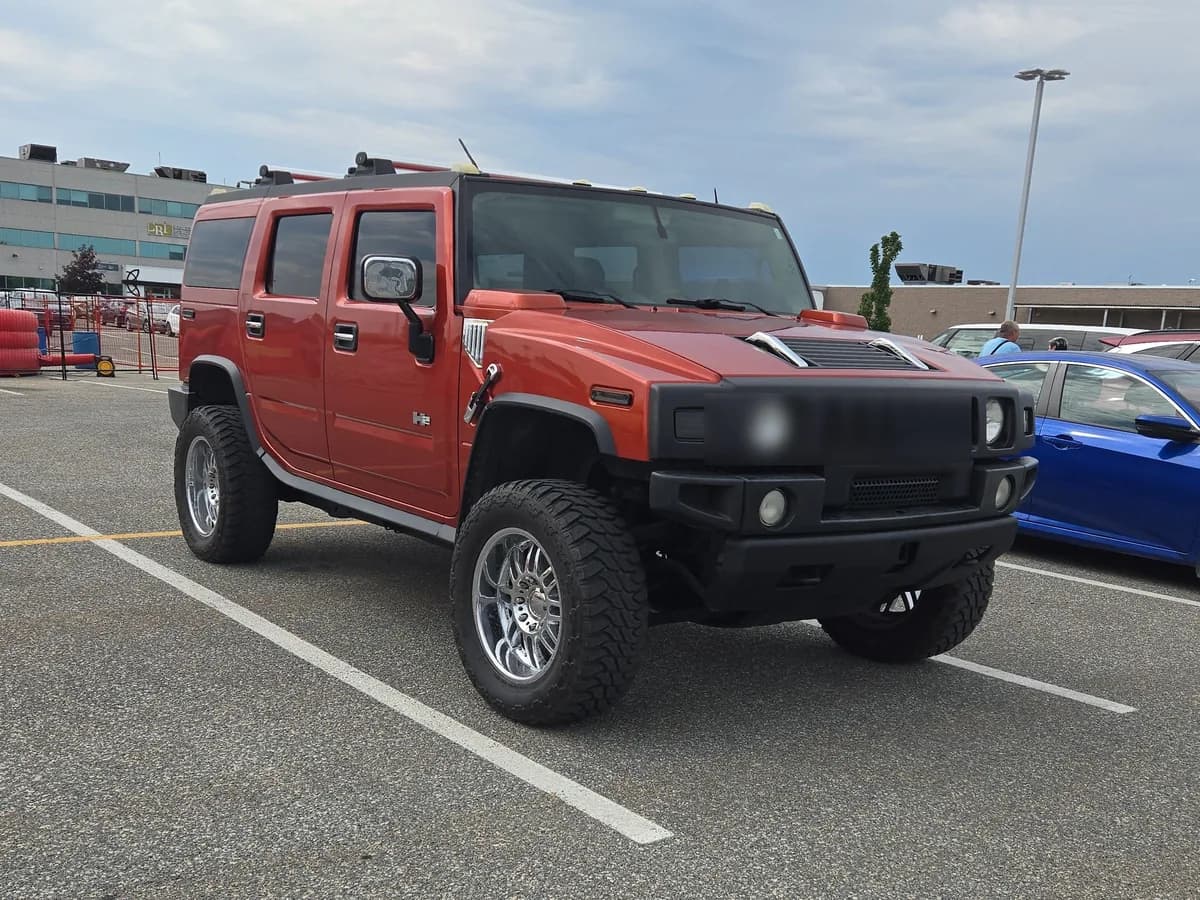
A HUMMER H2 is immediately recognizable by its tall, upright body, visually separate fender forms and rectangular front grille with vertical openings. Heavy bumpers, side steps and large tires reinforce its utility-inspired appearance. Five doors combined with a fully enclosed rear body generally identify the H2 SUV configuration. (jdpower.com) To identify an H2 SUT, look for the open cargo bed behind the passenger compartment. The rear window can be lowered and the Midgate folded to create a longer opening between the cabin and the bed. An externally mounted spare tire is another useful visual clue on the SUT configurations described in contemporary automotive coverage. (motortrend.com) HUMMER badging, the grille design and the vehicle’s overall proportions help separate the H2 from an H1 or H3, but they may not establish the exact model year. Confirmation should come from the VIN, manufacturer label, registration documents or a brochure for the relevant market. (gsi.ext.gm.com)
Important versions
Two configurations are especially important within the period covered. The H2 SUV is the enclosed body style introduced for 2003. It combines five doors, a large passenger compartment and a 6.0-liter gasoline V8 with four-wheel drive and low-range gearing, as described in the factory documentation. (assets.gm.com) The H2 SUT appeared for 2005. It retained the H2’s general structure and styling but replaced the enclosed rear section with an open cargo bed. Its folding Midgate allowed the separation between the cabin and cargo area to be reconfigured. The SUV-versus-SUT distinction is therefore mainly a body-style and usability difference rather than a complete model change. (motortrend.com)
References
- 2003 HUMMER H2 Owner’s ManualGeneral Motors
- HUMMER H2 Model Years and HistoryJ.D. Power
- First Drive: 2005 Hummer H2 SUTMotorTrend
- Hummer H2 SUT First Drive ReviewCar and Driver
- 2003 Hummer H2 BrochureGM brochure archive
- HUMMER H2 Model HistoryHemmings
- https://www.motortrend.com/reviews/129-0602-2005-hummer-h2-sut-reviewmotortrend.com
Frequently asked questions
- What years was the Hummer H2 produced?
- ScanRacer's referenced versions cover 2003 - 2005.
- How many Hummer H2 examples are documented on ScanRacer?
- 5 published scans from 5 members, with the latest photo added in August 2026.